EssenceMind Books
The EssenceMind books explore consciousness as an organized architecture, expressed across different domains of human experience.
Each book stands on its own, while remaining grounded in the same underlying framework.
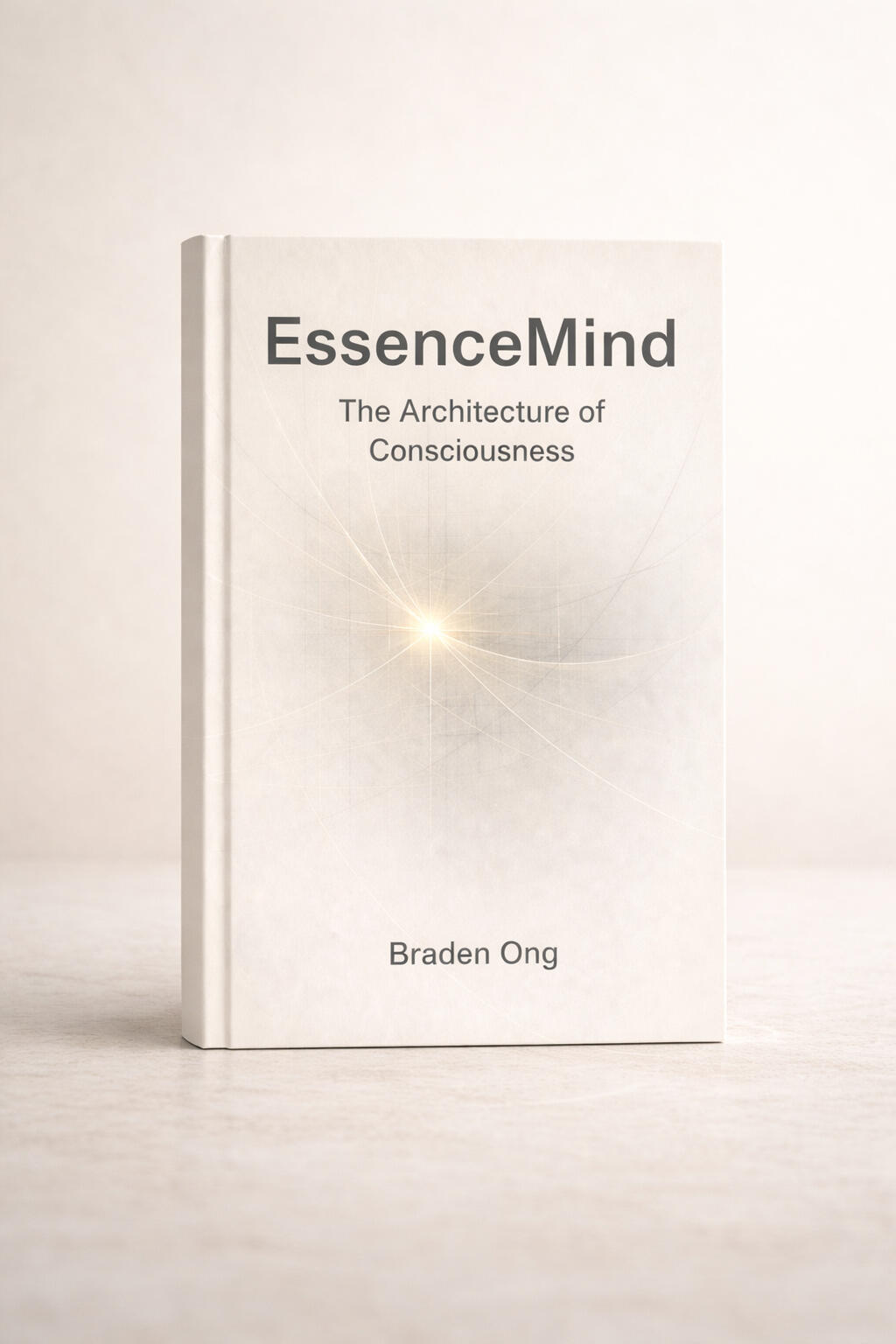
EssenceMind: The Architecture of Consciousness
The foundational work of the EssenceMind framework.This book introduces an architectural model of consciousness, describing how awareness, identity, perception, and coherence organize lived experience across inner life, relationships, and environments.
EssenceMind: The Architecture of Consciousness can be purchased here.

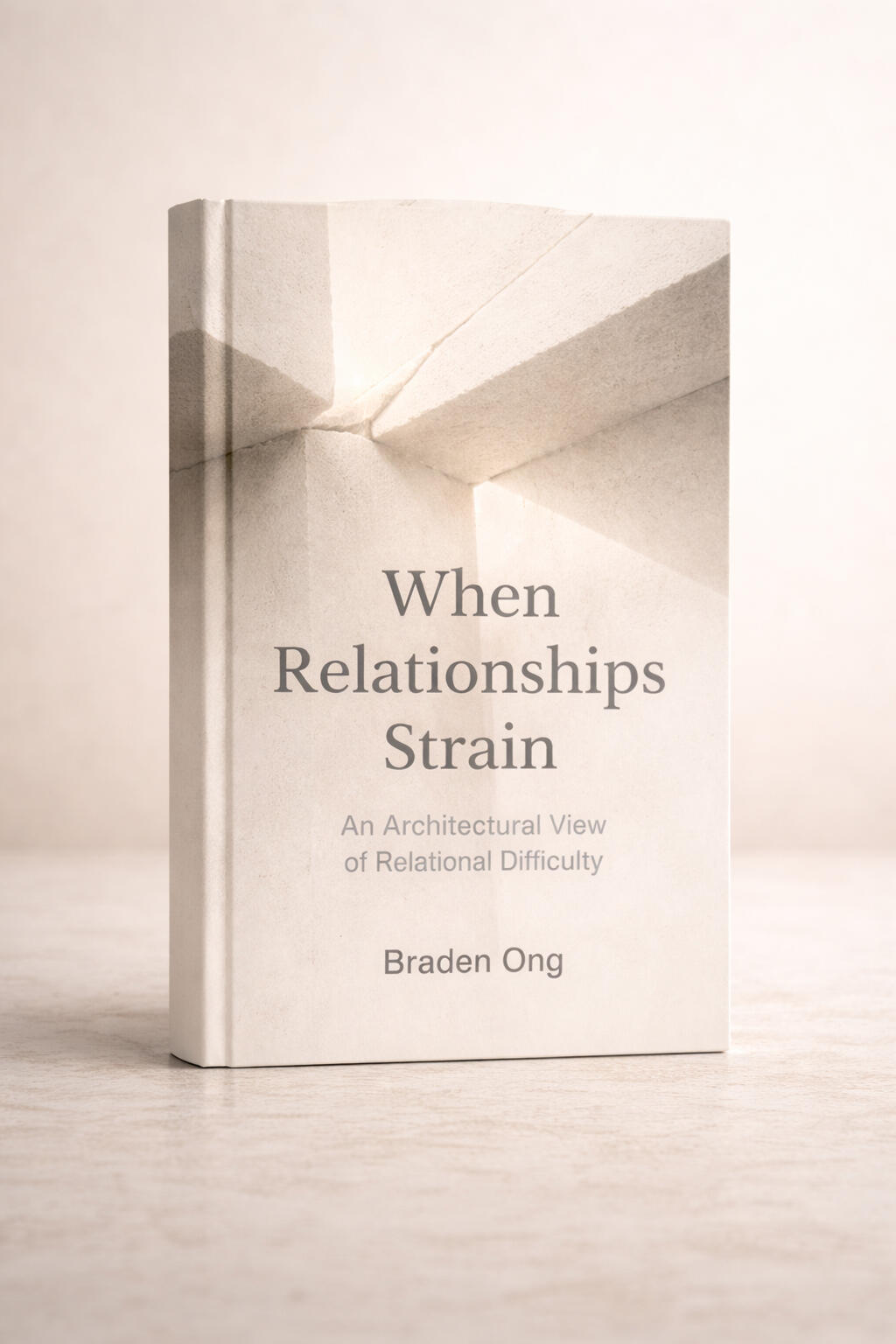
When Relationships Strain (coming soon)
An application of the EssenceMind architecture to relational experience.This book explores how relational strain arises not from personal failure, but from structural conditions within the relational field—and how clarity can emerge without forcing repair or resolution.
EssenceMind: The Architecture of Consciousness
Introduction
Many people assume that consciousness is something happening inside their mind—a private experience contained somewhere behind their eyes. But as I began studying brainwaves, meditation, intuition, relational psychology, and the influence of environments, a different picture emerged. Consciousness was a system we lived inside, rather than a thing contained within us.It did not behave as a fixed faculty. It reorganized with context, shifted with relational conditions, and revealed forms of intelligence that often preceded deliberate thought.Across thousands of experiences—from EEG sessions to deep conversations, from moments of awe to moments of rupture—I began to see the patterns by which consciousness reveals itself. These patterns were architectural. They showed how awareness opens and narrows, how identity expands and contracts, how perception becomes layered or literal, and how coherence holds everything together during moments of truth.The more I studied, the more I realized something essential:
Consciousness is not random. It is structured. And when you understand its structure, you can understand yourself.Not the surface self—the performative identity built from conditioning—but the deeper architecture beneath it: the self that knows what is true, what is aligned, what is coherent, what is yours to hold.This book is about learning to inhabit your architecture with sensitivity and honesty. It introduces a new way of understanding consciousness—EssenceMind—a framework that describes how your inner world organizes experience across four dimensions: awareness, identity, perception, and coherence.But more importantly, this book examines how architecture becomes visible in lived experience. It is present in the ways emotion is interpreted, intimacy is held, and challenge is met. It shapes how environments are selected, how intuition is registered, and how truth is felt within the body. Coherence itself becomes observable as a fluctuating condition, appearing and receding across the ordinary movements of a day.This work is grounded in patterns that can be recognized within one’s own experience, not as a method of change, but as a way of seeing. The architecture does not need to be constructed or improved; it only needs to be noticed as it expresses itself within real moments of living.My intention is simple:to give you a language, a map, and a felt understanding of the intelligence already moving through you.Not to tell you who you should be, but to help you see who you have always been beneath the noise.As you read, you may find yourself recognizing patterns you’ve lived your entire life but never had words for. You may feel moments of clarity, moments of discomfort, moments of resonance—each part of your architecture awakening to itself.EssenceMind is an invitation.An invitation to return to coherence, to truth, to presence, to the shape of your deepest self.Welcome to the journey.
The following chapter introduces the perspective that guides the entire work.
It does not attempt to explain or apply the framework in full.Readers who resonate with this orientation will find the rest of the book unfolds it carefully and in depth.
Chapter 1 — Rethinking Consciousness: The Emergence of the EssenceMind
Consciousness does not need to be improved.It needs to be understood.For most of human history, consciousness has been treated as something obvious. You are conscious when you are awake. You are more conscious when you are paying attention. You are self-conscious when you notice your own thoughts.Even in scientific and contemplative traditions, consciousness is often assumed rather than examined—something we recognize through its effects, but rarely through its underlying structure.Yet the more people tried to define consciousness, the more elusive it became.Philosophers debated whether it was the essence of mind or a by-product of complexity. Neuroscientists searched for its neural correlates—synchronized rhythms, global integration, networks lighting up and quieting down. Psychologists described it as awareness shaped by memory, emotion, and attention. Meditation traditions described it as a field that could be trained, purified, transcended, or dissolved.Each of these perspectives held a fragment of truth.Yet most shared an unspoken assumption: that consciousness is fundamentally the same in everyone.In this inherited view, people differ only in degree—more or less calm, more or less regulated, more or less attentive—but the underlying structure is presumed to be uniform. We assume that clarity looks the same for everyone, that insight arises the same way, that emotional presence, intuition, depth, focus, and self-awareness follow a single internal logic.When someone struggles to concentrate, we assume they need more discipline. When they become emotionally overwhelmed, we assume they lack regulation. If meditation does not bring clarity, we label the mind “busy.” And when people arrive at decisions differently, we tend to treat one method as correct and the other as deviation.Almost no one questions the starting point:
What if consciousness is not one thing? What if it varies at the level of architecture?Once you begin to look for this, the evidence appears in ordinary experience.One person understands life through patterns, another through images, another through bodily sensation, another through emotional resonance. One person gains insight in silence, another in movement, another in conversation. One perceives nuance through logic, another through intuition, another through metaphor.Even the experience of being “yourself” differs. Some sense themselves primarily as observers. Others as feelers. Others as interpreters, movers, or translators of experience.They reflect something deeper—distinct ways consciousness organizes itself from the inside.
And once this becomes visible, the question of what consciousness is begins to change.The EssenceMind emerges from this shift in perspective.It begins with the recognition that consciousness is a structure—a living architecture through which experience moves and takes form. Awareness participates as one dimension of this architecture. Identity participates as another. Perception, emotion, intuition, memory, imagination, and coherence each contribute to shaping how consciousness functions in any given moment.Imagine consciousness not as a spotlight or a container, but as an ecosystem.In a forest, soil, water, air, light, sound, and living organisms interact continuously. A change in one element affects the whole. Consciousness behaves similarly. Thoughts, emotions, sensations, memories, impulses, imagery, and insight are movements within a larger system rather than isolated events.When the system is fragmented, these movements collide.When the system is coherent, they align. The EssenceMind is the name we give to that alignment.
It belongs to a different category than mystical states, techniques, or concentration practices. The EssenceMind is what occurs when consciousness organizes itself according to its own design—when its components enter relationship rather than competition.To sense this more clearly, imagine the ecosystem becoming an orchestra.In ordinary experience, the instruments rarely listen to one another. A thought becomes too loud. An emotion pushes everything else aside. A memory hijacks attention. Intuition is drowned out by doubt. The music is jagged, fragmented, unresolved.But in certain moments—rare, but recognizable—the instruments fall into tune. They respond to one another. A subtle coherence emerges. The sound has not become simpler; it has become integrated.That moment is the EssenceMind.When people touch it—whether through crisis, stillness, or unexpected clarity—they often describe a sense of spaciousness opening inside them. There is more room to feel, and to think without becoming tangled.Perception becomes layered and dimensional.Awareness widens naturally as a consequence of alignment, rather than through effort.
Identity shifts as well. Instead of experiencing yourself as the stream of thoughts, emotions, and reactions, you begin to sense yourself as the presence behind experience—the grounded center from which clarity, authenticity, and truth arise.This presence is felt rather than conceptual. Many people describe it as the difference between performing themselves and being themselves.In this coherence, decisions simplify as the architecture resolves internal conflict and moves as a unified system. Relationships deepen as perception clears from defensive contraction. Creativity flows as the mind allows its intelligence to move without interruption. Emotional experience organizes as meaningful information, contributing depth and continuity rather than disruption.
Clarity emerges through alignment without forcing.The EssenceMind does not require quiet thoughts, a blank mind, or the suppression of emotion. Instead, it reveals how consciousness functions when it is allowed to express its inherent intelligence—when it is permitted to be what it actually is.This framework differs from many that came before it because it does not treat consciousness as a skill to be perfected or a uniform process to be trained. It treats consciousness as architecture—individual, inherent, and deeply intelligent.Each architecture has a natural way it returns to clarity, processes complexity, senses truth, and stabilizes after disruption. What supports one architecture may interfere with another.A person whose clarity emerges through imagery should not be told their mind is too active. Someone whose intelligence expresses itself through emotional depth should not be told to detach. Global pattern perception should not be forced into linear reduction. And a person who understands life through structure should not be asked to dissolve form.When consciousness is misunderstood, people spend years trying to function in ways that contradict their design. They chase techniques that do not fit, standards that do not apply, or ideals that have little to do with how their architecture actually works. Natural movements are misinterpreted as flaws. Confusion is treated as personal failure rather than as a mismatch between method and architecture.The EssenceMind changes this.Many people have already tasted it, even without language—those moments when clarity arrives suddenly, without effort, after a breath, a pause, or a subtle softening inside.It reframes clarity as something that emerges rather than something you force. Intelligence becomes architectural rather than earned. Consciousness is no longer something to maintain, but something that moves.As you learn to recognize your EssenceMind, your experience of yourself begins to shift. Complexity becomes more coherent. Emotions lose their threat because they can be felt without pulling you into their center. Relationships become less reactive because presence no longer requires collapse or defense. Decisions lose their confusion because the deeper architecture beneath competing impulses becomes visible.These shifts unfold nonlinearly and do not eliminate difficulty, yet they transform how difficulty is metabolized.You begin to sense an internal orientation—a subtle movement toward coherence and away from fragmentation. At first it is faint, then bodily recognizable. It is the architecture learning itself. Consciousness remembering how to organize around Essence.As this familiarity deepens, life is lived less from habit, fear, or compensation, and more from truth.The EssenceMind meets challenge directly. Life will still disrupt, stretch, confuse, and break you open, yet it provides a different place to stand.At the same time, it is important to name what this framework does not do.EssenceMind is descriptive. It does not explain suffering away, soften harm, or reinterpret loss. It does not speak to the meaning of violence, nor does it attempt to reconcile tragedy into a larger narrative. Some events in human life are unequivocally wrong, devastating, and irreparable—and understanding the conditions under which they arise does not make them acceptable, justified, or normal.This framework describes how human systems organize under different conditions of awareness, identity, perception, coherence, and ecology. In some contexts, that organization supports dignity, restraint, and care. In others, it collapses into patterns that permit or produce harm—sometimes on a massive scale. Describing these patterns does not place responsibility on those who are harmed, nor does it equalize victim and perpetrator. Violence is not a shared architectural failure; it is imposed by systems that have lost access to coherence and restraint, often amplified by collective and environmental conditions.EssenceMind does not claim authority over anyone’s experience of suffering. Grief, anger, moral clarity, and refusal of explanation are not obstacles to understanding; they are coherent responses to overwhelming threat and loss. This framework exists alongside those realities, not above them. It is offered as a way of seeing how human systems function—available when the system has the capacity to engage it, and silent where explanation would trespass.When difficulty arises, you can feel the architecture contracting. When clarity returns, you can feel it expanding. Fragmentation is no longer interpreted as failure, but recognized as a natural phase—often the moment just before deeper coherence becomes possible.This marks the beginning of a relationship between you and your own consciousness—one grounded in understanding, collaboration, and trust.In the chapters that follow, we will explore the architecture that underlies the EssenceMind: the dimensions through which consciousness expresses itself, the natural range that shapes your default mode, the expanded range that becomes available through growth, and the ecological dimension that reveals how environment shapes the inner field.You will learn how to recognize your architecture in real time, how to support its movements, how to navigate challenge without fragmentation, and how to live from coherence more consistently.The EssenceMind is an invitation into a different experience of yourself, beyond theory. A remembrance of how your consciousness was always meant to function. A glimpse of the intelligence that has been operating in you all along.Not as an ideal to reach—but as something already, intermittently, present.And this is where the journey begins.
The EssenceMind: The Architecture of Consciousness book is
available for purchase here.